
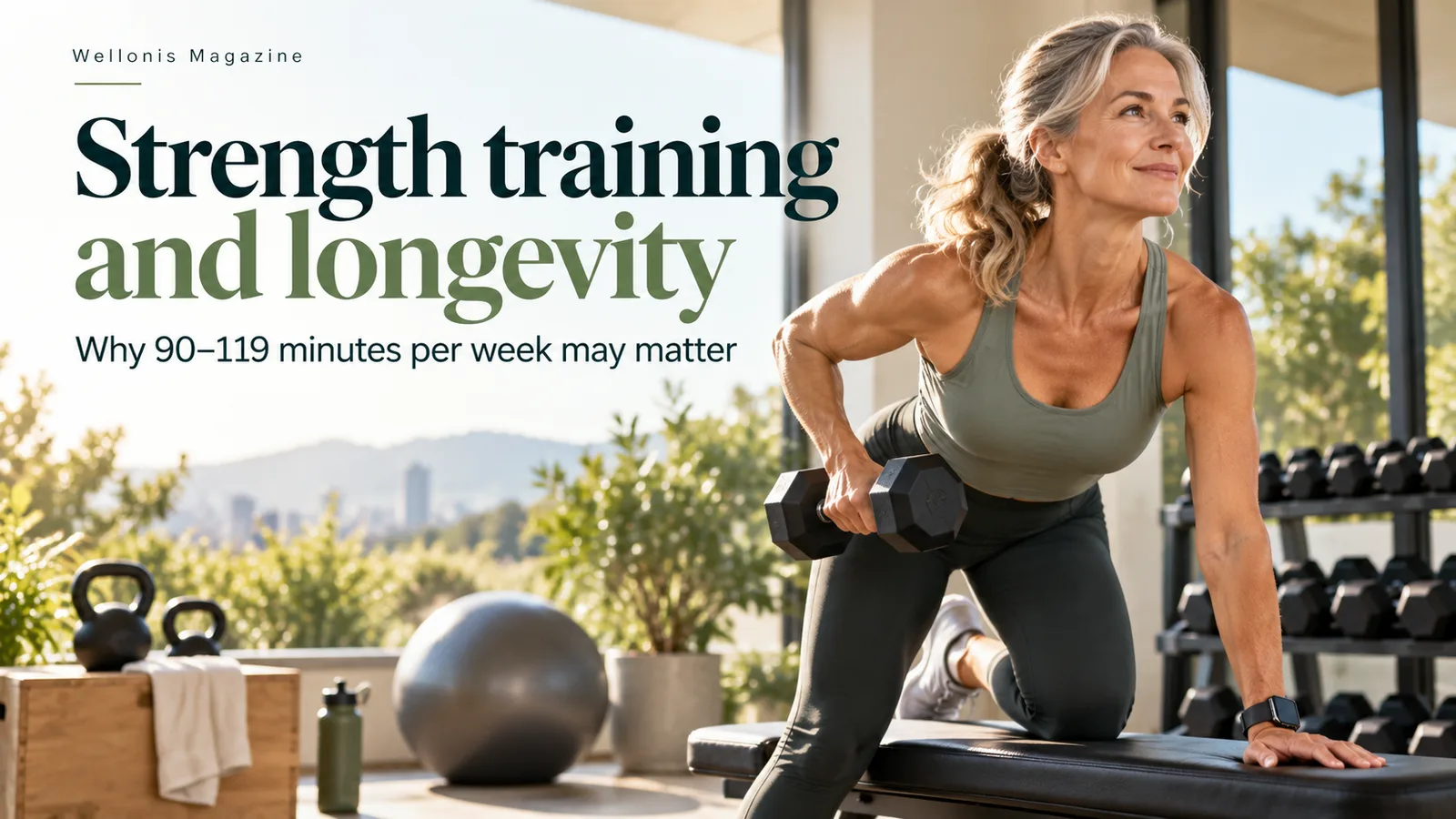
Strength training and a longer life: the 90-minute sweet spot
Wellonis team · 17 Oct 2026 · 2 min read
Following more than 147,000 adults for up to 30 years, researchers found that about 90 to 120 minutes of strength training a week was linked to lower risk of early death.
Lifting weights is usually sold as a way to look better. A large study published in the British Journal of Sports Medicine in 2026 suggests it may also be one of the more useful habits for a long and healthy life.
What the researchers did
Researchers at Harvard analysed data from 147,374 men and women in three long-running US studies of health professionals, some followed for up to 30 years. Participants regularly reported how much time they spent on resistance training and on aerobic exercise, and the team looked at how those habits related to deaths from any cause and from specific diseases.
What they found
Compared with people who did no strength training, those who did about 90 to 119 minutes a week had:
- around a 13% lower risk of death from any cause,
- around a 19% lower risk of death from cardiovascular disease,
- around a 27% lower risk of death from neurological disease.
The benefits did not keep growing in a straight line with more time in the gym. The lowest risk was seen with roughly 90 to 120 minutes a week, and people who combined strength training with regular aerobic exercise did best of all.
What it means for you
- You don't need to live in the gym. 90 to 120 minutes a week is two or three sessions of 30 to 45 minutes.
- It's not cardio or weights. The strongest results came from doing both. Keep your walks, rides or runs, and add strength work.
- Start simple. Bodyweight squats, push-ups, rows with a band, or a basic machine circuit all count. A coach can help you learn good technique and progress safely.
Source
Zhang Y, Lee DH, Rezende LFM, Ma Y, Giovannucci E. Long-term resistance training with all-cause and cause-specific mortality: assessing dose-response and joint associations with aerobic physical activity. British Journal of Sports Medicine, 2026. Read the study


Comments
No comments yet. Start the conversation.
Log in or create a free account to comment.