
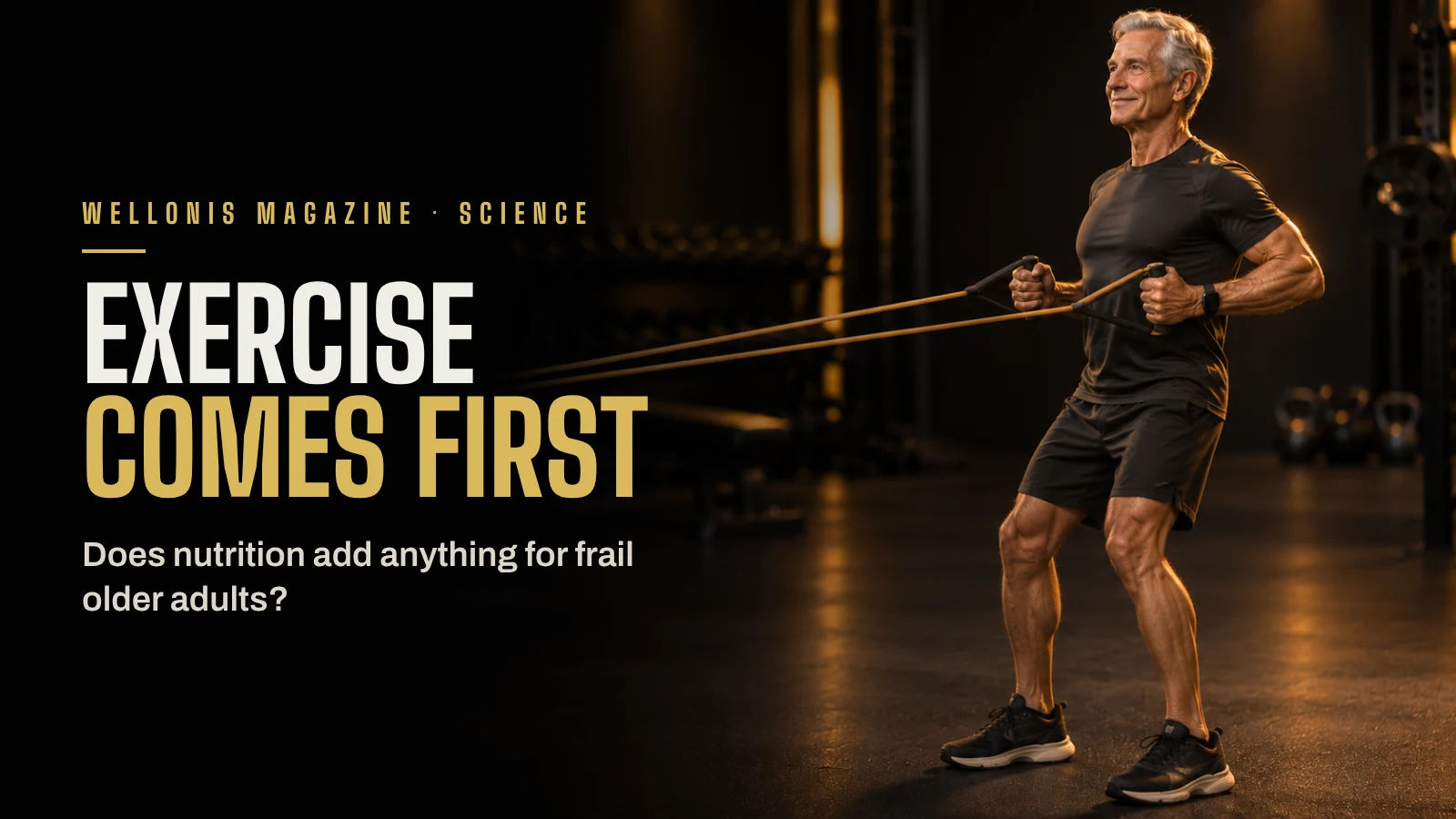
Does adding nutrition to exercise help frail older adults? One review says the evidence is unclear
Wellonis Science Desk · 9 Nov 2026 · 3 min read
A new review of trials in older adults finds structured exercise consistently helps frailty, but whether nutrition adds anything on top is still an open question.
Most of us have heard that strength work and good food are both good for ageing well. But for frail older adults, a new review asks a sharper question: does adding nutrition to an exercise programme help beyond the exercise alone?
What the study did
The researchers carried out a systematic review. That means they searched the research literature using a set plan, then sorted the results by strict rules. They searched three databases (PubMed, CINAHL and Scopus) and kept only randomised controlled trials that clearly defined frailty. The people in those trials were aged 65 or over and lived in the community, meaning in their own homes rather than in care settings.
From 2,447 records found, 10 publications met the criteria. Two reviewers screened them independently and checked the quality of each trial. The studies differed a lot in design and in what they measured, so the team could not combine the numbers into one overall result. Instead, they used a narrative method called Synthesis Without Meta-analysis, which summarises findings in words and tables. They also rated how confident we can be in the evidence.
What it found
- Two trials directly looked at frailty reversal, meaning whether people moved out of the frail category. Both favoured structured exercise.
- One of those trials showed an extra benefit when exercise was combined with a nutritional supplement.
- Across the studies that reported it, the odds of frailty reversal ranged from two-fold to five-fold.
- Other studies reported modest improvements in the risk of mobility disability, lean body mass and functional performance.
- Certainty of the evidence ranged from low to high, held back by small samples and differences between studies.
The reviewers' core message is that structured exercise consistently benefited frailty-related outcomes. Whether nutrition adds anything on top of exercise is not settled.
What it means in the gym
Exercise is the clear workhorse here. For anyone over 65, or a coach working with them, the most useful takeaway is that planned, progressive training is the part with the most consistent support. "Structured" means regular sessions, a clear plan for progression and steady attendance, rather than occasional walks when there is time.
A few practical ideas that follow from this:
- Build a routine around strength, balance and walking, and increase the challenge gradually over time.
- Treat nutrition as a separate question. If you are wondering about a supplement, that is a conversation for your doctor, not a shortcut bolted onto training.
- Track how you function, not just the number on the scale. Notice how easily you get up from a chair, how far you can walk, and how steady you feel on your feet.
- Keep a simple training log so you and your coach can see what is changing over weeks and months.
If you have a health condition, are recovering from an injury, or take any medication, talk to your doctor before starting or changing an exercise programme.
The limits of this study
This is one review, and its conclusions depend entirely on the trials it could find. Only 10 publications met the criteria, and few of them tested frailty directly. Many samples were small. The studies also varied in their design, length, type of exercise, nutrition content and the way frailty was measured, which is why the reviewers avoided combining their numbers. Because of this, the certainty of the evidence ranged from low to high. The review also does not tell us how the findings apply to people outside the age group it covered or to those living in care settings. The authors themselves say that firm conclusions cannot be drawn yet and call for more standardised trials.
If you want help turning a plan like this into a routine that fits your life, a Wellonis coach can work through it with you step by step.
The study
PubMed: PMID 42949507


Comments
No comments yet. Start the conversation.
Log in or create a free account to comment.