
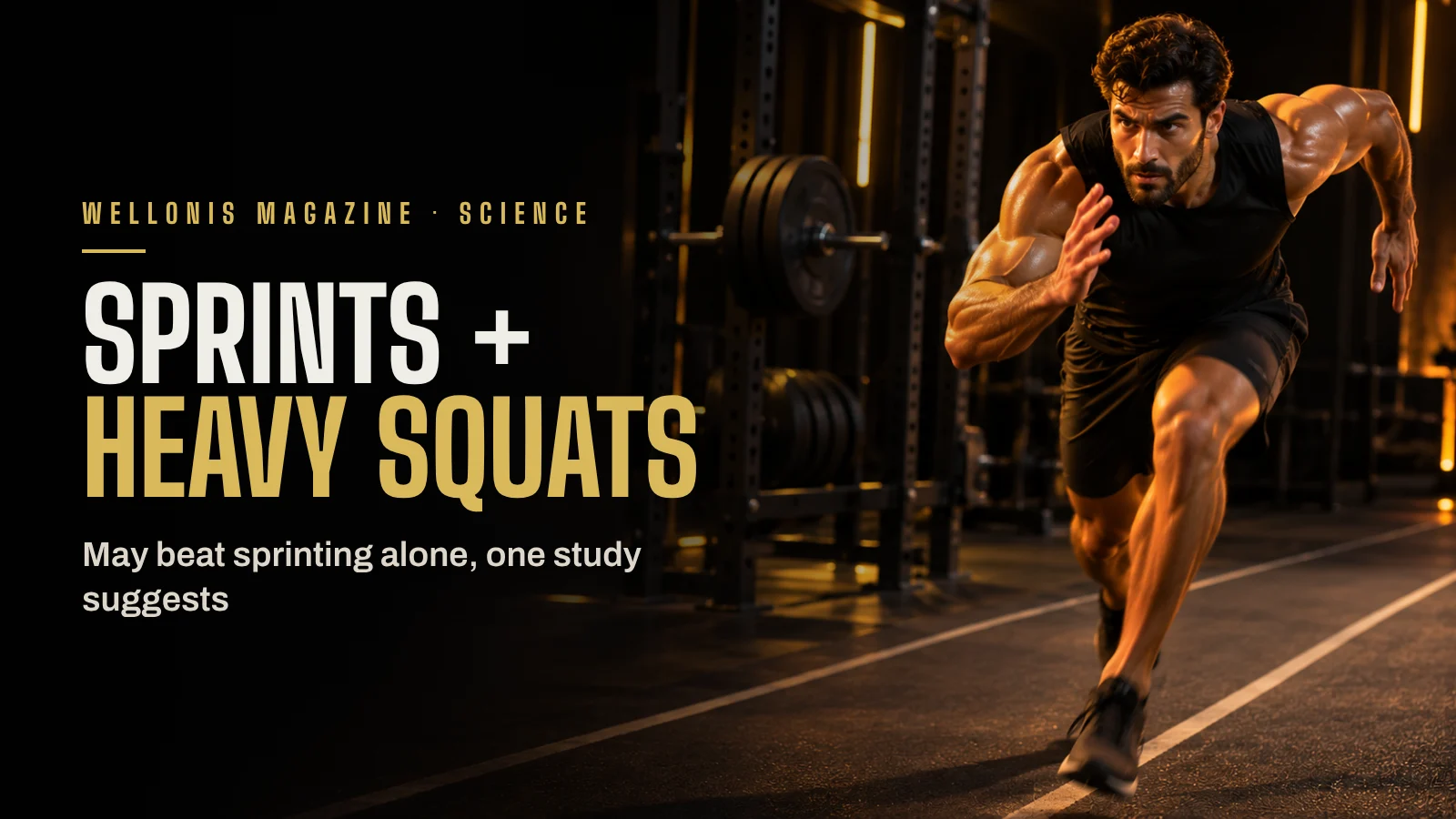
Sprints plus heavy squats may beat sprinting alone, one study suggests
Wellonis Science Desk · 9 Nov 2026 · 4 min read
A new study compared sprinting alone with sprinting plus three styles of strength training. Heavier squats stood out, but this is a single exploratory study.
If you already sprint and want to get faster or more powerful, do you also need to lift? A new study tackled that question directly, and its answer is more interesting than a simple yes or no.
What the study did
A research team recruited 58 recreationally active men and women who did not do structured strength training. Participants were randomly assigned to one of four groups for eight weeks. Everyone did sprint work twice a week, using six sprints of 25 meters. Three of the groups also did strength training three times a week, each using a different method:
- Maximal strength: four sets of four squats at 85% or more of one-rep max.
- Hypertrophy (muscle-building): three sets of 8 to 12 squats at roughly 70 to 80% of one-rep max.
- Explosive strength: four sets of six to seven squat jumps using body weight.
The fourth group was the control group. They sprinted but did no strength training.
The researchers measured maximal strength, explosive strength, sprint performance, some endurance measures including running economy, and a 30-second cycling test called the Wingate.
What it found
Several of the results favoured the heavier training styles:
- Leg press maximal isometric force rose 14.5% after maximal strength training, compared with 5.2% after explosive training. Hypertrophy training also beat the sprint-only group, with a 10.6% gain.
- Rate of force development in the squat, a measure of how quickly you can produce force, improved 37.4% after maximal strength training and 36.0% after hypertrophy training. Both beat the sprint-only group.
- The 0 to 25 meter sprint time improved by 0.11 seconds more after maximal strength training and 0.10 seconds more after hypertrophy training than in the control group.
- Running economy improved 2.5% more after maximal strength training than in the control group.
- On the Wingate test, average power rose 6.6% after maximal strength training and 6.9% after hypertrophy training. Peak power rose 11.8% and 10.1% respectively. Both of these gains were larger than the control group's.
It is worth noticing what these numbers compare. In most cases, the study is showing that one group improved more than another, not simply that a group got better. The explosive jump group did not show the same extra gains over sprinting alone in sprint and most other tests. The authors also found that changes in maximal strength were linked to changes in performance, and they attributed the improvements mainly to gains in maximal strength.
What it means in the gym
If your goal includes faster sprinting or more power, this study points toward heavier strength work as the more useful partner for sprints. The maximal strength and hypertrophy groups did better than the sprint-only group across several tests, while jump-based work on its own did not add much here.
Some practical takeaways, without turning the study into a prescription:
- Sprinting on its own may not be the full answer if you want to build strength alongside speed.
- Moderately heavy lifting, not just light or fast lifting, seems to matter in this study.
- Progress gradually. The study used specific loads and rep ranges over eight weeks, and jumping straight into heavy work is a different thing from building up to it.
- If you have an injury, a health condition, or you are pregnant or taking medication, talk to your doctor before changing your training.
A coach can help you work out how to fit this kind of approach into your own week and recovery.
The limits of this study
This is one study, and the authors describe it as exploratory and hypothesis-generating. That means it is best read as a reason to test an idea, not as proof.
- The authors used Fisher's least significant difference tests for comparisons between groups. This approach is less strict about false positives, so some of the differences could be chance findings.
- The programme lasted eight weeks, which is short. We do not know what happens over longer periods.
- Participants were recreationally active but not strength-trained. Results may look different for experienced lifters or elite athletes.
- The findings come from one group of people in one research setting, so they may not transfer to every sport or training background.
Treat this as an interesting clue rather than a settled answer, and see how it fits your own goals.
The study
PubMed: PMID 42975894

Comments
No comments yet. Start the conversation.
Log in or create a free account to comment.