
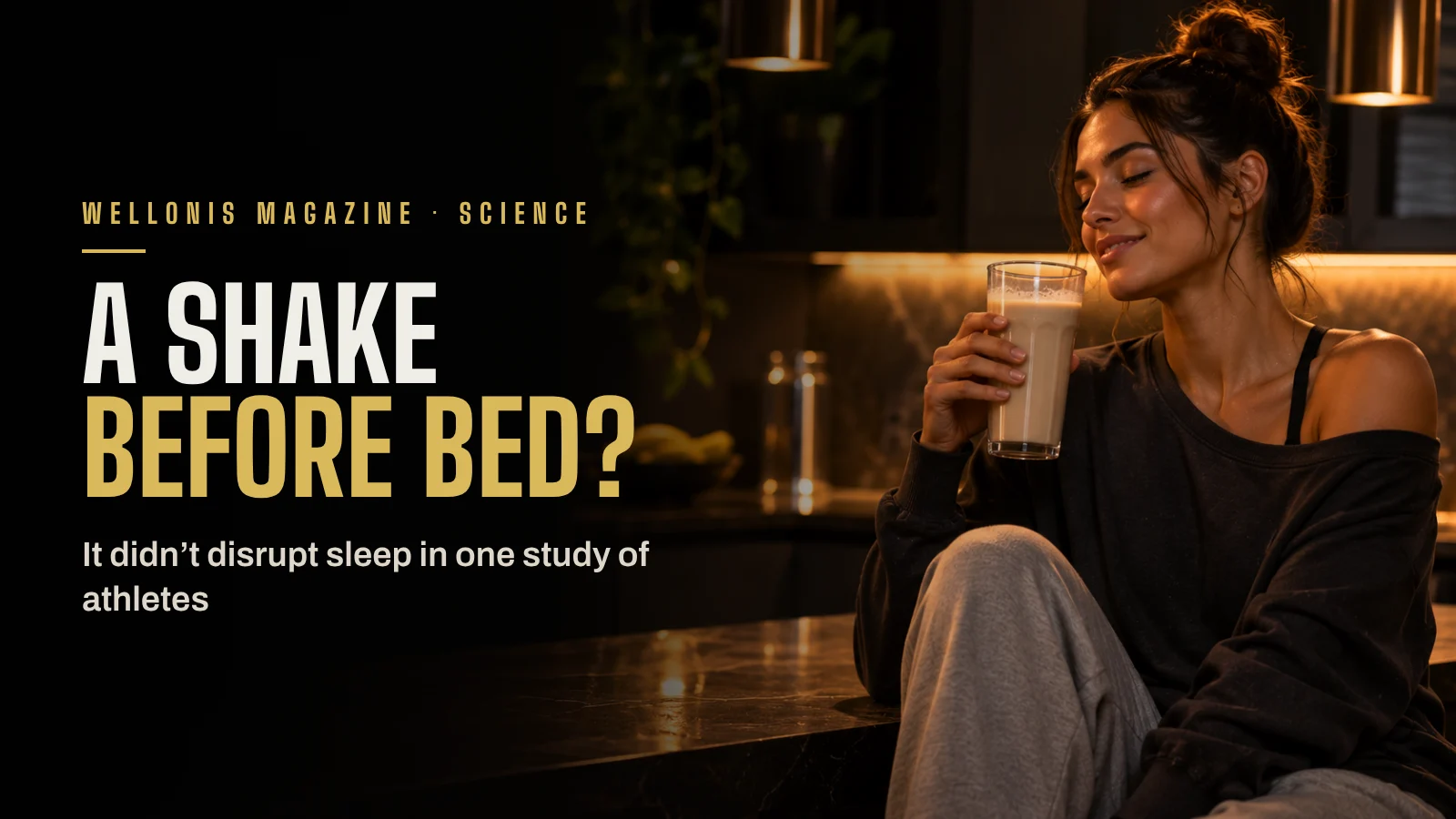
Pre-bed protein or carbs didn't disrupt sleep in one study of female college athletes
Wellonis Science Desk · 9 Nov 2026 · 4 min read
One new study tested a pre-sleep drink in young female athletes. Sleep and recovery held steady across all four drinks, including the placebo.
Eating close to bedtime has a bit of a reputation problem. Many people worry that a late snack will keep them awake or make them feel sluggish in the morning. Yet some athletes are increasingly interested in a small pre-sleep feed, hoping it might support recovery overnight. A new study looked at whether that habit could get in the way of sleep or recovery in a specific group: elite young women competing at a high level.
What the study did
The researchers recruited 25 female athletes aged 18 to 25 who competed in NCAA Division I, a top tier of university sport in the United States. Of those, 21 finished the trial.
Each athlete tried four different pre-sleep drinks, one type at a time, for three nights in a row. The options were a milk-derived protein called casein, a milk-derived protein called alpha-lactalbumin, a carbohydrate drink, and a placebo with almost no calories. The drinks were taken about two hours after the last meal and roughly 30 minutes before bed, so they were the final thing eaten each day. A gap of at least three days separated each drink, and neither the athletes nor the people assessing the results knew which drink was which.
The team tracked sleep and recovery in two ways. A wearable device recorded measures such as total sleep time, how long it took to fall asleep, sleep efficiency, resting heart rate, and heart rate variability. Each morning, athletes also filled in short questionnaires about how well they slept, how long it took them to nod off, and how recovered they felt. In a smaller group of six athletes, a glucose sensor was worn overnight to see how blood sugar changed while they slept.
What it found
The main result was reassuring but not exciting. None of the four drinks changed the sleep or recovery measures in a meaningful way compared with the placebo.
Total sleep time stayed between 7.47 and 7.62 hours across the conditions. Sleep efficiency sat between 91.5% and 92.0%. Resting heart rate and heart rate variability also barely moved. On the questionnaires, sleep quality ranged from 69% to 75%, time to fall asleep ranged from 16 to 20 minutes, and self-rated recovery ranged from 61% to 66%. None of these differences were large enough to count as a real effect.
In the overnight glucose sub-group, blood sugar changed over the night as you would expect, but the type of drink made no clear difference. Because this part only included six athletes, it is hard to read too much into it.
What it means in the gym
The practical takeaway is that a pre-sleep feed did not seem to hurt sleep or recovery for these athletes. That matters if you are already considering a bedtime snack and want to know whether it might backfire.
It is important not to overstate this. The study did not show that any of these drinks improved sleep or made training more productive. The researchers concluded that pre-sleep feeding can be added without harming sleep, which is a fair reading of their data, but it is a much more modest claim than "this helps you recover."
If you are curious about trying a bedtime snack, a few sensible steps follow from this work:
- Keep your usual eating pattern as the base, and think of any pre-sleep food as an extra, not a replacement for meals.
- Notice how you feel the next morning, including how rested and recovered you feel, over several days rather than one night.
- Stay consistent so you can tell whether the change is making a difference for you.
- If you have ongoing sleep problems, a medical condition, or take medication, talk to your doctor before changing your evening routine.
A Wellonis coach can help you test a change like this in a way that fits your training load and schedule.
The limits of this study
This is one study, and it should be read as one piece of a bigger picture. Several factors limit how far the results can be applied.
- The group was small, with 25 athletes starting and 21 finishing. It also included only female athletes at one competitive level, so the findings may not carry over to men, to recreational exercisers, or to other sports.
- Each drink was tested for only three nights. Longer-term effects, or effects that build up over weeks of training, were not measured.
- The sleep and recovery data came from a consumer wearable and self-reported questionnaires, not a sleep laboratory. These tools are useful for spotting trends but are not as precise as lab-based testing.
- The glucose analysis included just six athletes, so it can only hint at what is happening.
- The study measured sleep and recovery, not athletic performance, strength, or body composition.
Overall, this is a careful, well-designed trial that found no harm from a pre-sleep feed in this group. It is a useful reassurance, but it is not the final word on whether bedtime eating helps athletes recover.
The study
PubMed: PMID 42897977

Comments
No comments yet. Start the conversation.
Log in or create a free account to comment.