
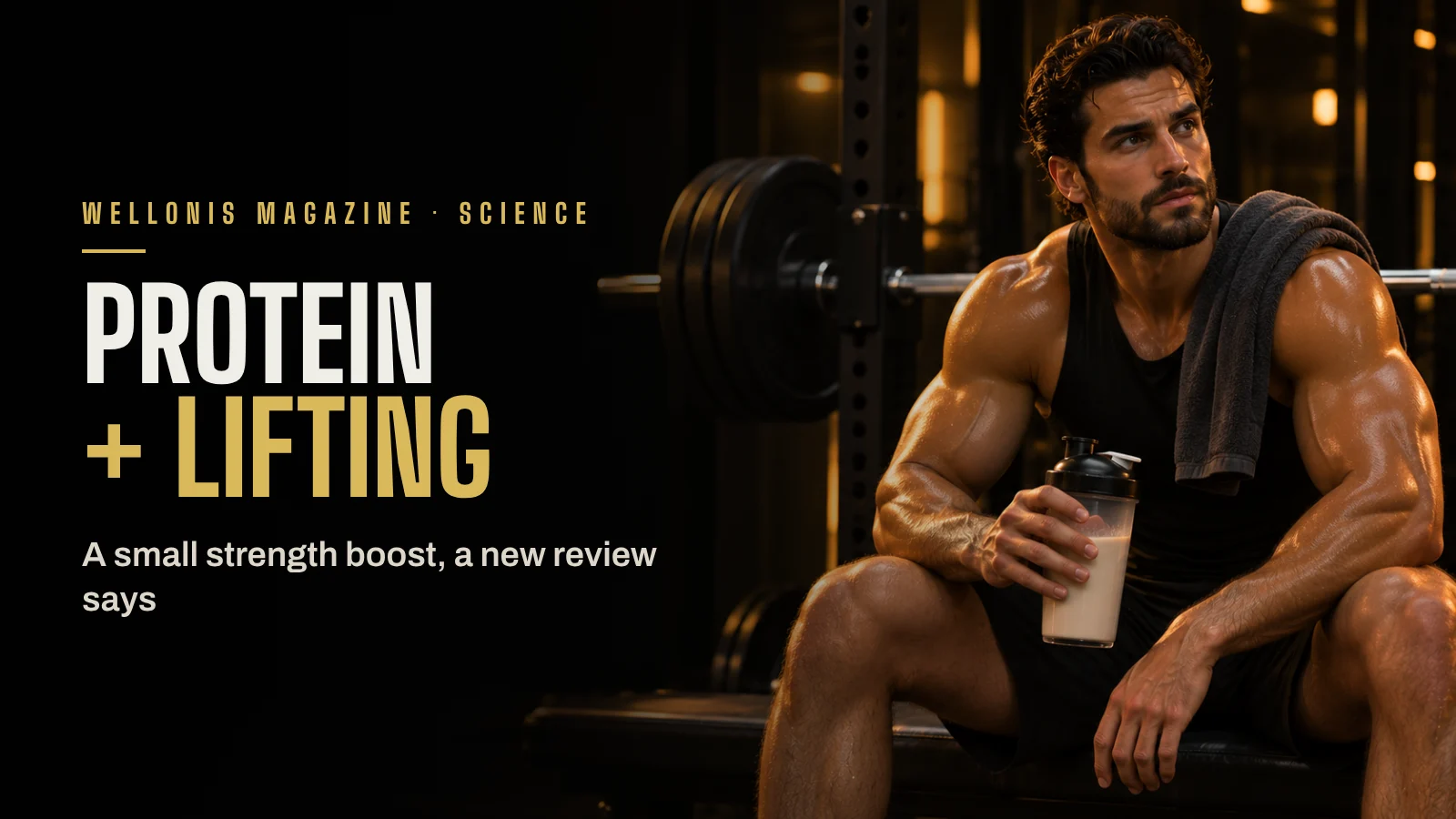
Does protein add extra strength to lifting? One new review says maybe
Wellonis Science Desk · 9 Nov 2026 · 4 min read
A new meta-analysis of young adults found that protein alongside weight training was linked to small strength gains, but the benefit depended on several factors.
If you lift weights and also drink a protein shake, you may have wondered whether the shake is doing anything beyond what training already does. A new meta-analysis set out to answer that question for healthy young adults. Its findings are interesting, but they are more nuanced than a simple yes or no.
What the study did
The researchers combined the results of earlier studies. They searched four research databases through April 1, 2026, and pulled together 23 randomized controlled trials involving 611 healthy young adults. Each trial compared people doing resistance training alone with people doing resistance training and taking protein supplements. The review was registered in advance on PROSPERO, a public register for systematic reviews, which helps show the authors planned their methods before looking at the results.
Because the studies used different protocols, the team used a statistical approach called a random-effects model to combine them. They reported their results as weighted mean differences, which describe the average gap between the two groups in kilograms lifted. They then looked for reasons the results varied between studies, using subgroup analysis, meta-regression (a way of testing whether factors such as trial length explain differences), and sensitivity tests that removed studies one at a time to check the findings held up.
What it found
Adding protein to resistance training was linked to small but statistically significant improvements in two lifts:
- Bench press: an average advantage of 2.63 kg (95% confidence interval 0.77 to 4.49 kg, p = 0.006)
- Squat: an average advantage of 7.40 kg (95% confidence interval 2.15 to 12.66 kg, p = 0.006)
In plain terms, the confidence interval is the range the true average effect probably sits within, given the data. Both ranges stayed above zero, which is why the authors called the results significant. But the ranges are fairly wide, so the true effect could be smaller or larger than the middle estimate.
The squat benefit looked strongest in certain situations. It was mainly seen when the intervention lasted 12 weeks or less, or when protein was taken both around workouts (before and/or after) and before sleep. Meta-regression identified intervention duration as a significant factor (p = 0.037). Protein timing was a borderline factor (p = 0.073), meaning it did not clearly reach the usual threshold of significance. The authors also reported that their sensitivity tests kept the pooled effects significant and pointing in the same direction.
The conclusion adds that the extra benefit seems to depend on training background and baseline protein status, meaning how much protein people already eat. The abstract does not give numbers for these two factors, so they should be treated as the authors' interpretation rather than a measured result.
What it means in the gym
This review suggests that, for healthy young adults, protein supplements may give a modest boost to strength when they are added to a proper training programme. It does not suggest that protein replaces training, and the study did not test people who skipped it.
Some practical takeaways, read with caution:
- Training remains the main driver. Progressive overload, consistent sessions and good technique came first in every group studied.
- Your total daily protein matters more than any single shake. The review did not standardize doses or sources, so it cannot tell you a specific amount to aim for.
- Timing is a detail with weaker evidence. The study hints that spreading protein around workouts and before bed may help squats, but the result was only borderline for timing.
- Your starting point may matter. If you already eat plenty of protein, extra supplements may do less. The authors flagged this idea but did not measure it directly.
If you have a kidney condition, another health problem, or take medication, talk to your doctor before changing your protein intake.
The limits of this study
This is one meta-analysis, and it has real limits. The trials differed in protocol, duration, protein dose and source, and the authors noted that these details were often not clearly reported. Heterogeneity, meaning variation between studies, was present, and the timing and duration findings came from subgroup and regression analyses, which are less certain than the main pooled result. The study also measured strength only, not muscle size or long-term outcomes. It included healthy young adults only, so the findings may not apply to older people or those with health conditions. The authors themselves called for larger, well-powered trials that report protein doses and sources, measure habitual protein intake and use stratified designs.
So the honest summary is this: protein supplementation combined with resistance training was linked to small strength gains in young adults, and the size of that benefit appears to depend on the situation. It is a useful piece of the puzzle, not the whole picture.
If you want help fitting this kind of evidence into your own routine, a Wellonis coach can work with you on it.
The study
PubMed: PMID 42947921


Comments
No comments yet. Start the conversation.
Log in or create a free account to comment.